
Skip to content
Navigate by A to Z A B C D E F G H I J K L M N O P Q R S T U V W Y Z or full list of Services

An Introduction to Scrutiny

Download a copy of the Introduction to Scrutiny Booklet  683.49 KB PDF File

Introduction

The local government Act 2000 required all councils in England and Wales to introduce new political structures which provide a clear role for the council, the executive and non executive councillors.

One of the key roles that was introduced for non executive councillors is to undertake an overview and scrutiny role for the council.

What does Overview and Scrutiny Involve?

The overview and scrutiny role involves:

  • Holding the executive to account 
    This involves scrutinising decisions of the executive at a number of different stages of the decision making process: before decisions are made; before they are implemented; and after they are implemented.
     
  • Policy Review and Development
    Policy review involves the in-depth scrutinising of existing council policies to examine intended policy outcomes and whether these outcomes are being achieved.

    Policy development involves shaping the formulation of key policies, through examining alternatives set against needs, resources and other issues and making recommendations to the executive.
     
  • Review of Council Services
    This involves scrutiny reviewing council services to ensure they are achieving customer satisfaction and value for money together with monitoring council performance and ensuring standards are met.
     
  • External Scrutiny
    External scrutiny involves scrutinising the work and impact of external agencies on a council's community e.g. local NHS Trusts and other partners

Scrutiny does not make policy decisions that are the responsibility of the cabinet. Scrutiny makes recommendations and therefore for those recommendations to be effective they have to be made by a fully involved scrutiny panel backed up by good research and consultation with reasonable conclusions and recommendations.

Centre for Public Scrutiny

The Centre for Public Scrutiny Link to external website (CfPS) has been created to promote the value of scrutiny in modern and effective government - not only to hold executives to account but also to create a constructive dialogue between the public and its elected representatives - to improve the quality of public services.

A guide to good scrutiny has been published by the CfPS and sets out four principles for good scrutiny as:

  • Providing 'critical friend' challenge to executives as well as external authorities and agencies
  • Reflecting the voice and concerns of the public and its communities
  • Taking the lead and own scrutiny process on behalf of the public
  • Making an impact on the delivery of public services 

Scrutiny in Tameside - Structure/Operation

How does Scrutiny fit in with the political structure of the Council?

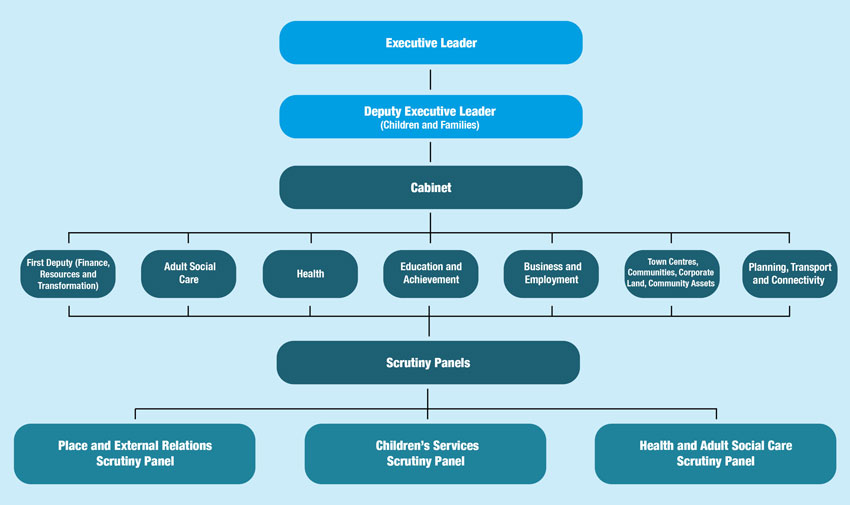
There are 57 elected Councillors in Tameside. 10 Councillors are portfolio holders and form the Executive Cabinet. While the Executive makes all the Council’s decisions within the budget and policy framework set by full council, it is the scrutiny function that provides the checks and balances in the political structure. A member of the Cabinet is not allowed to sit on a Scrutiny Panel.

The diagram, 'The Council at Work', illustrates how the Scrutiny Panels relate to the Council.

Scrutiny Panel’s comprise of non executive Councillors and are politically balanced. In order to gain the best outcomes for local people, members of Scrutiny Panels work across political boundaries with a common-sense, objective approach to reviewing council policies which results in informed and considered recommendations for improvement.

How does Scrutiny Operate in Tameside?

Tameside Council has a strong scrutiny function which has a positive and constructive ethos, which aims to improve services to the public by scrutinising the policies of the Council and how those policies are put into practice.

Vision for Scrutiny in Tameside
"Overview and Scrutiny in Tameside is positive, objective and constructive, it aims to add value to any service that it considers. It acknowledges good practice and recommends improvements where necessary. Scrutiny seeks to engage the community of Tameside and address inequalities in the Borough."

Scrutiny in Tameside operates through four scrutiny panels which meet in public at least once a month, usually at the Council Offices, Wellington Road, Ashton-under-Lyne. In addition to non executive councillors scrutiny panels comprise some co-opted members and people who have experience or knowledge of the subject under consideration.

Personal and Health Services Scrutiny Panel

The Personal and Health Services Scrutiny Panel has responsibility for considering all elements of housing policy, adult social care in accordance with Health and Social Care Act 2003 and local National Health Trusts.

In the past, the Panel has considered the operation of New Charter Housing, Home Care Services from a Carer's Perspective, Facilities for Disabled People in Town Centres and Dental Provision in Tameside.

Scrutiny of local NHS Trusts was introduced from 1st January 2003 as part of the Government's patient and public participation agenda. The Scrutiny Panel has worked with local Patient and Public Involvement Forums and places for forum members are made available on the Scrutiny Panel. This practice has continued with Local Involvement Networks (LINks) that replaced Patient and Public Involvement Forums in April 2008.

The Scrutiny Panel has been closely involved with a proposal for the reconfiguration of children's and maternity services in Greater Manchester, Lancashire, Cheshire and Derbyshire, together with proposals for the reconfiguration of the Tameside and Glossop PCT.

In Tameside, Health Scrutiny is aimed at improving people's health by looking at the quality, performance, accessibility and outcome of NHS services in the Borough. This is achieved by meeting staff from the Hospital Foundation and Primary Care Trusts and undertaking cross-cutting, thematic scrutiny exercises and service reviews, looking at the outcome of health and social care provision provided to all the people of Tameside.

This Scrutiny Panel provided the only public accountability for the hospital when there were concerns about the standards of care for elderly and vulnerable people.

In relation to the Council, the Panel relates to subjects covered by the Warrant of Office for the Cabinet Deputy, Personal and Community Services.

Resources and Sustainable Communities Scrutiny Panel

The Resources and Sustainable Communities Scrutiny Panel has the responsibility for considering matters relating to corporate policies, strategies and governance, resource planning, election development, human resources and legal services. It also deals with community based policies, including the Tameside Strategic Partnership, District Assemblies and sport, recreational and cultural policies, including sport and leisure provision made by, or on behalf of the Council.

The Scrutiny Panel is also concerned with information technology, crime and disorder, equalities, together with procurement and marketing strategies. In particular, the panel relates to the subjects generally covered by the Warrants of Office for the First Cabinet Deputy and the Cabinet Deputies responsible for Community Services and Co-ordination Services.

Recently, the Scrutiny Panel was designated the “Crime and Disorder Committee” with responsibility for scrutinising the Crime and Disorder Reduction Partnership in accordance with the Police and Justice Act 2006.

Services for Children and Young People Scrutiny Panel

The Services for Children and Young People Scrutiny Panel was created at the Annual Business Council Meeting held on 23rd May 2006, and reflects changes to the service provision following the introduction of the Children Act 2004 in response to “Every Child Matters.”

This means that the Panel has scrutiny responsibilities for the Services to Children and Young People Service Area and Partnership and the cabinet warrants of office relating to Children and Young People and Lifelong Learning. This includes all education services, schools, educational achievements, children’s health, social work, looked after children, the Youth Service and the Youth Offending Services.

As well as undertaking far reaching policy reviews, the Panel also monitors the achievement and success for the Council’s Building Schools for the Future proposals, Key Stage and GCSE results and the outcome of service inspections and assessments.

The membership of the Scrutiny Panel includes non-executive councillors together with places for six co-opted members representing Parent Governors, The Church of England, Roman Catholic Church and two places for other faiths. Through the Tameside Multi Faith Network the Panel has managed to recruit representatives of the Muslin and Hindu faiths to take these places.

Technical Economic and Environmental Services Scrutiny Panel

The Technical, Economic and Environmental Services Scrutiny Panel has the responsibility for considering all elements of Council policies in relation to the provision of engineering and transport services, environmental health and the environment in which we live and the economy and prosperity of Tameside.

The Scrutiny Panel gives consideration, therefore, to economic development and regeneration policies and the Council’s policies for the management of its assets.

The Panel has considered the Council’s policies with regard to environmental health, refuse collection and recycling, but its areas for consideration also include pest control and food hygiene. The Scrutiny Panel has considered the buildings, roads, footpaths and grounds maintenance of the cemeteries and crematorium, Section 106 Planning Agreements and the Ashton and Hyde Renewal areas.

This Scrutiny Panel relates to the subjects covered by the Warrants of Office for the Cabinet Deputies for Economic Services, Environmental Services and Technical Services.

The diagram below outlines the four scrutiny panels and their connection to the 10 cabinet portfolios and statutory external organisations. 

Diagram showing the four Scrutiny Panels and their connection to the cabinet portfolios and statutory external organisations
View a Larger Version of the Diagram

Scrutiny Panels and their relationship to the Local Strategic Partnership and Local Area Agreement

The Local Government and Public Involvement in Health Act 2007 added to scrutiny powers and placed a duty on named organisations to co-operate with LAAs and also a duty on these organisations to respond to scrutiny in relation to targets of the LAA with which they are involved, including responsibilities on partner organisations to provide information in response to scrutiny requests, and to have regard to scrutiny recommendations.

Local Strategic Partnership

 Local Strategic Partnerships are non-statutory, multi-agency partnerships which bring together the different parts of the public, private, community and voluntary sectors at a local level. Tameside Strategic Partnership (TSP) brings together more than seventy organisations from all sectors, which are committed to working together to improve quality of life in the Borough of Tameside.

The aim of the Tameside Strategic Partnership is to deliver the vision for Tameside set out in the Community Strategy 2003-13. The Community strategy is the borough’s ‘strategy of strategies’ and aims to improve quality of life for local communities and reduce inequalities by identifying one clear set of long-term priorities for the borough to promote economic, social and environmental well being.

The six priorities identified in the Tameside Community Strategy are:-

  • Supportive Communities
  • A safe Environment
  • A Prosperous Society
  • A Learning Community
  • A Healthy Population
  • An Attractive Borough

The Tameside Strategic Partnership consists of seven thematic partnerships which focus on particular issues of importance to Tameside which are:

  • Children and Young People’s Partnership
  • Cultural and Community Cohesion Partnership
  • Crime and Disorder Reduction Partnership
  • Economic and Learning Partnership
  • Health Partnership
  • Housing Partnership
  • Older People’s Partnership

Local Area Agreement

A Local Area Agreement (LAA) is a three year agreement, based on local Sustainable Community Strategies, that sets out the priorities for a local area agreed between Central Government, represented by the Government Office (GO), and a local area, represented by the lead local authority and other key partners through the Local Strategic Partnership (LSP).

LAAs set out a series of targets the council must achieve and the funding streams government will pay to the council to enable it to meet them. As well as national targets negotiated with central government, the LAA includes local targets that are a priority for the local area as set out in the community strategy.

LAAs are structured around 4 blocks.

  • Children & Young People
  • Safer Stronger Communities
  • Healthier Communities & Older People
  • Economic Development

The table below shows the relationship of the Council’s four scrutiny panels to the seven thematic partnerships of the Local Strategic Partnership and local area agreement blocks.

The Personal and Health Services and Resources and Sustainable Communities Scrutiny Panels have developed and agreed Protocols to set out how people will behave and how matters will be handled when scrutinising issues involving local NHS Trusts and Greater Manchester Police.

Scrutiny Panels and their Relationship to Local Strategic Partnerships

Scrutiny Panels
Technical, Economic and Environmental Services for Children and Young People Personal and Heath Services Resources and Sustainable Communities
Pointer  Pointer Pointer Pointer
Thematic Partnerships in Relation to Scrutiny Panels
Economic and Learning Partnership Children and Young People

Health Partnership

Housing Partnership

Older People

Crime and Disorder

Cultural and Community Cohesion

 Pointer  Pointer  Pointer  Pointer
Local Area Agreement Blocks in Relation to Scrutiny Panels
Economic Development Children and Young People 

 Stronger Safer Communities

Healthier Communities and Older People

 Stronger safer Communities

Roles and Responsibilities of a Scrutiny Member/Support Officer

A Scrutiny Members role and responsibilities include:-

  • To attend and contribute to scrutiny panel meetings
  • To scrutinise Council policies
  • To gather evidence and undertake consultation

Scrutiny is a challenge for elected members and requires the following skills:-

  • Open questioning Skills
  •  Investigative Skills
  • Qualitative Judgements
  •  Commitment

Councillors on Scrutiny Panels will be offered training and development in the skills and knowledge required to undertake the scrutiny function.

Members are supported in their role by the Head of Scrutiny and four Scrutiny Support and Co-ordination Officers who each have responsibility for their own individual scrutiny panel. The role of the Scrutiny Support and Co-ordination Officer involves:-

  • Assisting members in developing an Annual Work Programme
  • Assisting members in designing Project Plans for topics under review
  • Project management of reviews
  • Undertaking research and producing written briefing papers and powerpoint presentations based on that research
  • Design and carry out consultation
  • Monitoring performance data
  • Draft Scrutiny Panel reports on behalf of the Panel

In addition, support officers:-

  • Organise scrutiny panel meetings
  • Prepare and distribute agendas
  • Record Minutes of the meetings

The Scrutiny Support Unit’s ‘Standards for Service Delivery’ is published on the Scrutiny website.

Scrutiny in Practice

Development of Scrutiny Panel Work Programmes

At the beginning of each Municipal Year each Scrutiny Panel agrees a Work Programme for the year.

Topics for inclusion in the work programme may be drawn from a number of sources including:-

  • Resident’s Opinion Survey
  • Suggestions from the Executive
  • Best Value Performance Indicators
  • Suggestions from elected members
  • District Assemblies
  • Members of the public

Scrutiny Panel Work Programmes consist of three types of work:-

In-depth Policy Reviews

In-depth reviews are longer term pieces of work involving investigations through research and consultation including face to face contact with relevant witnesses such as service providers and service users. Experience and discussion with elected members has shown that a successful scrutiny review incorporates the factors shown in the diagram below:-

Interesting to members

Identified by members

Based on good quality background research

Led by members

Based on conclusions and recommendations identified by members

Well Planned

Pointer Pointer Pointer

Not geographically specific

Based on learning from others

Pointer What makes a successful scrutiny review Pointer

Presented in a report which is easy to read

Carried out with officers involved in the service or issue

Pointer Pointer Pointer

Based on 'seeing' the issue through visits etc.

Important to members

Interesting to the public

Based on meaningful consultation

Important to council priorities

Completed according to timescales

Follow-up Reviews

Follow-up reviews determine the progress made with implementation of recommendations previously presented by a Scrutiny Panel. This enables the Scrutiny Panel to verify the outcomes of the agreed recommendations.

Performance Monitoring

Monitors the performance of a service in relation to achieving its targets.

It is important to consider however, when determining issues for a work programme that topics link with the Council’s priorities and that activities are timely, relevant and achievable.

Once agreed, Scrutiny Panel Work Programmes are published on the Council’s website and in the local press.

Scoping a review and preparing a project plan

Once a Scrutiny Panel has selected a topic for review from the annual work programme members of the Panel, with the assistance of the Scrutiny Support Officer identify:-

  • The aim of the review
  • Objectives – in order to meet the aim
  • Detailed actions to be undertaken to meet the objectives (evidence, stakeholders, consultation, site visits)
  • Equalities issues
  • Value for money/efficiencies
  • Anticipated timescale

Examples of Project Plans are available on the Scrutiny Panels' website

Information and evidence

The Scrutiny Support and Co-ordination Officer will send an agenda to Panel members at least five days prior to a meeting. In order to prepare members for a meeting the Scrutiny Support and Co-ordination Officer will provide a written briefing document outlining background research on the topic to be discussed along with suggested discussion issues. The Panel is then further supported with a powerpoint presentation which takes place in a private scrutiny panel briefing session approximately 45 minutes immediately prior to the meeting commencement time.

The review process usually takes place over several meetings. Once Scrutiny Panel members have assessed all the information and evidence received, the scrutiny panel report will be initially drafted by the Scrutiny Support Unit based on the information received during the course of the review. The draft report will not contain conclusions or recommendations, which will be agreed for inclusion in the report by the members of the Scrutiny Panel.

Response from the Executive

Once a Scrutiny Report is complete with conclusions, recommendations and observations of the Borough Treasurer with regard to financial implications and the Borough Solicitor with regard to legal implications, the report will be presented to a meeting of full council by the Chair of the Scrutiny Panel.

Although the relevant Cabinet Deputy will respond verbally, and the report may be debated, a written response which details whether recommendations have been accepted or rejected and what action is proposed to implement the recommendation is received on an agreed template within 15 working days from the date the report is presented to Council.
The Executive Responses are published on the Scrutiny website.

Scrutinising Scrutiny

Performance of Scrutiny is monitored by the following performance indicators:-

The percentage of recommendations contained in Scrutiny Panel reports that are accepted by the Executive and have been put into practice, as verified by a Follow Up Review and Report.

The percentage of recommendations relates to the recommendations contained in a Scrutiny Panel Review Report, which is produced by a Scrutiny Panel and presented to Council. The only Scrutiny Panel reports that are presented to Council are those produced following a review.

The Council's Executive is required by Scrutiny Protocol to respond to the Recommendations contained in a review report and indicate whether each recommendation is accepted and whether it will be implemented. If a recommendation requires ongoing repeated action, implementation will be deemed to have occurred when the first action is put into place. The implementation of Review Reports will be monitored by the respective Scrutiny Panel as detailed above. The data to support this performance indicator is collected on an annual basis from May to April each year.

The percentage of Scrutiny Panel members who feel that Tameside Scrutiny Panels add value to the services that they review and that they are engaged with the scrutiny process

Data to be collected following an annual customer survey of all Scrutiny Panel members, to be undertaken through questionnaires.

The percentage of Scrutiny Panel members means:

  • the percentage of Scrutiny Panel members returning questionnaires, who responded ‘agree’ or ‘strongly agree’ when asked to indicate their level of agreement or disagreement with the following statements:
    • “I feel that Scrutiny adds value to the services it reviews”
    •  “I feel that my contribution as a Scrutiny Panel member helps Scrutiny add value to the services it reviews.”
  • the percentage of Scrutiny Panel Members who responded with ‘4’ or ‘5’ when asked:
    • “On a scale of 1 – 5, how involved do you feel you are in Scrutiny

The percentage of Scrutiny Panel members (either councillors or co-opted) who attended meetings of Scrutiny Panels.

Attendance at a Scrutiny Panel meeting means both scheduled and special meetings of Scrutiny Panels.

The percentage of people on the Tameside Citizens' Panel who indicate that they have an awareness and understanding of scrutiny in Tameside.

The Tameside Citizens' Panel is a consultation group of some 2000 members from across the Borough. The make up of the Panel changes annually. Each year the members of the Panel are consulted on their knowledge of scrutiny and the work of the Scrutiny Panels.

The number of people who when asked:

"Have you heard of Tameside Scrutiny Panels before receiving this questionnaire?" and "How aware are you of the work of the Tameside Scrutiny Panels?" - Answered fully or partially.

Scrutiny Contacts

  • Megan Nurse - Assistant Chief Executive, Policy and Performance
  • Howard Boots - Head of Scrutiny
  • Hannah Easby - Personal and Health Services Scrutiny Panel
  • Alison Davies - Resources and Sustainable Communities Scrutiny Panel
  • Gaynor Alexander - Services for Children and Young People Scrutiny Panel
  • Muna Clough - Technical, Economic and Environmental Services Scrutiny Panel
  • Gina Murphy - Web/Business Administration
Contact Information
Send us a Message Send us a Message
Contact by post

Scrutiny Support Unit
Tameside MBC
Council Offices
Wellington Road
Ashton under Lyne
Lancs
OL6 6DL

View local map Map image
Contact by Telephone
0161 342 3160
Contact by Fax
0161 342 2102

__________________________

1 Improvement and Development Agency (I&DeA)


Page last updated: 22 October 2008